CLICK HERE FOR BLOGGER TEMPLATES AND MYSPACE LAYOUTS »

Wednesday, July 22, 2009

Pete Carroll

Pete Carroll's coaching career was jump started in 1973 when his former football Coach Chester Caddas offered him a position as a Graduate assisstant at University of the Pacific. This Allowed Pete to earn a Secondary Credintial and recieve a Masters Degree in Physical Education. From 1978 through 1983 Pete had various coaching positions at 4 different universities from the east coast to the west. From 1984 through 1999 Carroll moved on to the NFL, where he held several positions. After having disappointing seasons as head coach for the NY Jets and later for the NE Patriots it looked as though his career as a head coach might be over. He was released from the Patriots in '99. In 2000 when a head coaching position opened at USC, Carroll really wasn't what they were looking for but after trying a few venues he was the man to get the spot. Since then he has had a winning percentage of 85.4%, has made multiple trips to the National title game, and consistently won the Pac 10 conference title.

What I hope we can all take from Pete's story is that in coaching if we want to make it to where he is (making $2,782,000 a year) we must be willing to sacrifice and tough it out for what might be many years. If you read more about him you will see how many different places he coached and what the different pay scales were. To make it in this business you have got to be ready to dive in and give it all you have. For coaching opportunitites try these links:

Monday, July 20, 2009

Internships

I know I've said it before, but when it comes to bettering your chances of being successful in coaching, experience is absolutely invaluable. On CollegeView.com I read up a little on the importance of internships, they say "You no longer have to simply be more qualified than the person next to you, you have to be more qualified than countless others all around the world. Going to a college or university is a critical step, but you can greatly enhance your classroom learning by gaining real world experience through college student internships." They continue to explain how these are a great way to establish social networking, or in other words get your name out there. Thats why I've compiled a list of links that will lead you to a slew of sports related internships. As I searched I found that there are openingings all over the country and I realized these are opportunities that we can't afford to pass up.

Sunday, July 19, 2009

Forever Strong

I love a great sports movie, my wife laughs because I still shed a tear every time I watch Rudy. "Forever Strong" is not the greatest movie I have ever seen but I absolutely loved it because of the priciples found within.

If you look at my blog about "Coaching Pilosophies" you'll see I talk a lot about the difference between strategy and philosophy. "Forever Strong" is a prime example of these differences. Larry Gelwix is the head coach of the Highlands High Rugby team and throught out the film you see how he takes a personal interest in each one of his players. His goal is to not only build a winning team but to build character in each one of his players. In contrast one of Gelwix's opponents Richard Penning is all about x's and o's, strategy, and numbers.

I would recommend this film to all those who are coaching or looking to coach. We have a great opportunity to influence our players and shape their lives. Though my words may not be very convincing Gelwix's record is. In his 33 years of coaching at Highland he has won 379 games and lost only 9.

To watch the trailer click here:

Thursday, July 16, 2009

One Small Step For... Fan


One small step for fan, one huge step for fan-kind. Alright so nothing is official yet but steps are being made toward the investigation of fairness in the Bowl Championship Series. For years the BCS has baffled and frustrated fans and teams in the college football world. We never could figure out the reasoning behind it, well congressman Neil Abercrombie, a Democrat from Hawaii, is strongly voicing his opinion "Abercrombie said... college football is big business with hundreds of millions of dollars at stake. 'It’s money. That’s what this is all about,' he said." Abercrombie isn't alone, he is backed by Lynn Westmoreland (Republican-Georgia) and Mike Simpson (Republican-Idaho) in introducing a resolution to the unpopular BCS.

So what does this mean for coaches? It will offer more opportunities to reach the championship for coaches of teams like Boise State or Hawaii who have had perfect records in recent years but because of BCS stipulations were not afforded such an opportunity. For those of us climbing the coaching latter and who have not quite made it to the big name Division I schools like USC, OU, LSU, etc. we can reach the big games quicker with an abolition of BCS. This would jump start our careers and offer growth and financial improvement for the smaller schools where we may be working.

We have a responsibility to support this movement. Lets stay informed and engaged.

Here are some links to read up on more about the investigation:

Tuesday, July 14, 2009

Offseason Preparation

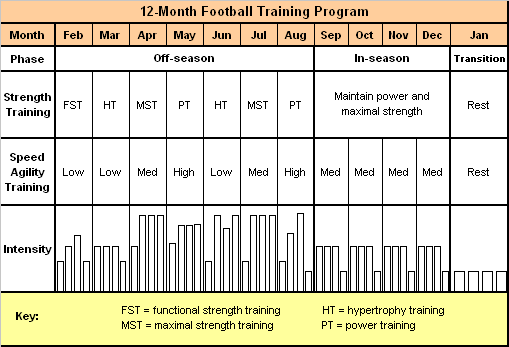
Generally what we do as a football program can be broken up into 3 time periods:


-Offseason

-In-season

-Transition


Interestingly these are listed in order of how much time is dedicated to each. About 7 months of our year is dedicated to offseason practice and conditioning, 4 months to in-season, and 1-2 months to relax your mind and body in a transition period.

When we look at it this way we realize just how crucial our offseason activities are. Here are some key points to remember as we get ready to move into our football season: (click on each to learn more)

Offseason work is the foundation that we build successful teams on. Follow these steps to make sure your team is well prepared to win from day 1.


Wednesday, July 8, 2009

Experience

Recently I read an article in USA football.com about the importance of getting in-field experience when interested in coaching football. Coach Tom Bass, the technical writer and advisor for USA Football, is a 30-year NFL coach, he wrote:

"Being a part of the football program in whatever way at the college you attend will be a real plus for your football education. If for some reason that does not happen, see if you can volunteer for a youth team or high school team and start your football experience at the same time you are in college.

Try to attend every clinic you can, go and visit any practice that is available and introduce yourself and visit with every coach that you can meet. Then take the time to keep in touch with each coach. Coaches move from job to job, openings occur and someone you have established contact with may be in a position to offer you a football coaching position."

When interveiwing for coaching positions what will jump off the page of your resume wont be what kind of GPA you had during college or even the degrees you have recieved (lets be honest most coaches' schooling is similar), it will be the experience that you have in coaching football.
Here are some links that will lead you to opportunities to volunteer and get involved in football programs near you:


Friday, July 3, 2009

Featured Coach Friday: "Big Game Bob" Stoops

Its not hard to see why Bob Stoops has become one of the highest paid and most well known coaches in college football. Everywhere Stoops has coached winning percentages have increased. It is hard to ignored someone when they make teams win every time they come around. He is so well known that one night when family of mine in Oklahoma knelt to say a nightly prayer their 4 year old daughter gave thanks for Bob Stoops. He began his coaching career at Kansas State in 1989 as a DB coach and then a co-defensive coordinator. In 1996 he went to Florida as a defensive coordinator. With both teams he helped them reach national contention and even was part of the National Championship with the Gators in 96. In 1999 Bob Stoops was hired as a head coach for the Oklahoma University Sooners. Since then the Sooners have only lost 2 home games and have won 1 National Championship, 4 bowl games, and 6 Big12 Championships.

So what is the secret to his success? We see part of it here in an article about the job interview that Joe Castiglione (Athletic Director, OU) had with Stoops:

Based on what Stoops says here and what we have seen in his career we can conclude that one of the keys to his success is that he doesn't waste time. For him the term "rebuilding process" does not exist, he takes care of business now. It took Stoops just ten years to excel from DB coach to head coach of a big name Division I school and it only took him one year to lead that struggling team to the 2000 National Championship and finish the season undefeated, outscoring 13 opponents by a combined 481-194.

Wednesday, June 24, 2009

Special Teams

It seems that all too often in football we spend 3 or 4 days a week practicing offense and defense and then the day before our game we spend 1 hour on covering kick off, kick off return, punt, punt return, PAT, PAT block, and feild goals. The reason why we don't spend enough time on special teams is that we do not understand their importance.

Let me break it down real simple:
When you control special teams you control field position.
When you control field position you win the game.

One of the difficulties we face when coaching special teams is a lack of player interest unless they get to touch the ball. There are different ways to adress this, of which 2 are:

  1. It must be important to you as a coach before it will ever become important for the player. Show a special interest in your special teams perhaps by allocating more time to them. (For example University of Hawaii starts and finishes every practice with a special teams drill)
  2. Provide an incentive. Come up with a rewards system or special recognitions for those who don't get the spotlight of touching the ball.

Here are some sights to learn more on the special teams coaching techniques:


Monday, June 22, 2009

Fitzgerald-ism

More and more today we see players trying to outdo each other not with level of skill but with end zone dances, trash talk, and show boatin'. Its tainting the image of our American sport. Take Terrell Owens for example, a great receiver and competitor but he can not let a game pass with out making headlines in an obnoxious way. Then there's Chad Johnson who has recently changed his name to Chad "Ocho- Cinco" in honor of his glorious number, who is also a great receiver.
In contrast one of the best players in the league Larry Fitzgerald does his talking with his undeniably reliable play. I can remember when I first watched Fitzgerald play when he was at the University of Pittsburgh. Initially I was impressed with his ability to catch anything that came near him but what struck me the most and has stayed with me through out the years was his conduct in between plays. I noticed that he would run quickly to and from the huddle. Upon finishing a play, no matter how big or small, he would promptly run to the nearest official and hand him the ball. There was never any talking or dancing, just classy, professional, competition.
Let us promote and exemplify this Fitzgerald-ism to our players that we may restore class through the old saying "Do your talking with your actions".

Tuesday, June 16, 2009

Coaching Philosophy

Recently I have been taking a look at my own coaching philosophy and I found it interesting to compare it with philosophies of other coaches that I could find online. First of all there seems to be some confusion between the deffinition of philosophy and strategy.

Philosophy: The rational investigation of the truths and principles of being, knowledge, or conduct. (Dictionary.com)

Strategy: A plan, method, or series of maneuvers or stratagems for obtaining a specific goal or result. (Dictionary.com)

Too many times while I was researching "philosophies" did I find something that resembled a strategy. I am convinced that to be successful in coaching it will take more than strategy, it will require an understanding of how to influence our players. I found it well put by Mike Singletary in this article on Suite 101.com when he said "If anyone would ask me what coaching really means, it's not really about winning. It's not really about Xs and Os. All of those things go into it, but it's about influence." Another quote from the article is "And the truly great coaches know how to influence not only the plays that are called on the field, but the minds and hearts of the players executing those plays."

Take a look at your coaching "philosophy" (if you have one, if you don't, work on one!) and make sure it doesn't get lost in strategy.
Here are some links that offer good advice on coaching philosophies:

"If you don’t have a distinct philosophy, then you haven’t decided what’s important to you. And if you don’t know what’s important then you won’t be able to tell your coaches or athletes what’s important. If they don’t know what your philosophy is, then they can’t be held accountable when they screw it up."- Pete Carroll (Sports Performance Coaching)